

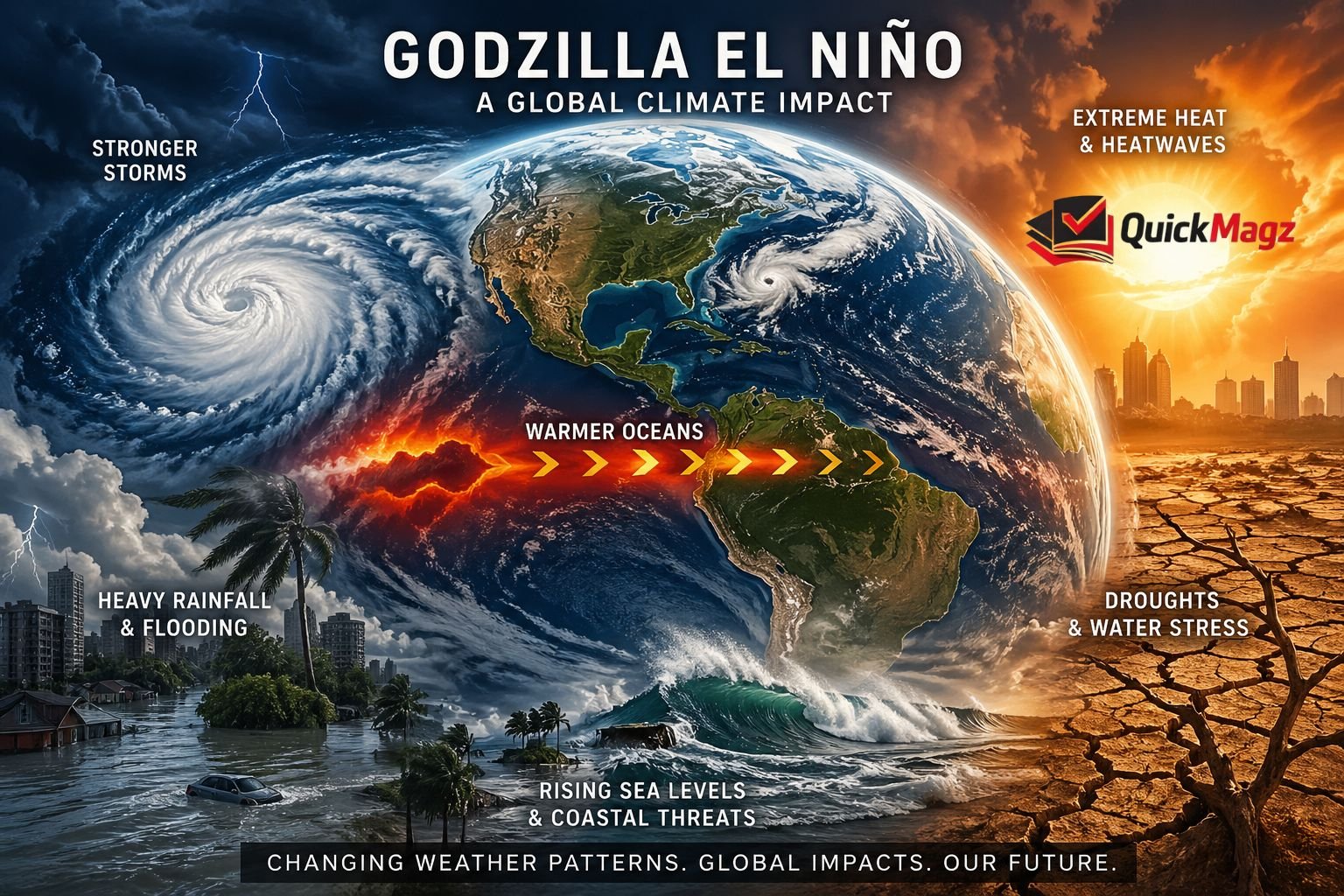
A Godzilla El Niño is not an official scientific term, but it is often used to describe an unusually strong El Niño event. The phrase became popular because powerful El Niño events can reshape weather patterns across the world, affecting rainfall, heat, storms, crops, oceans, and daily life.
El Niño is part of the larger El Niño-Southern Oscillation, or ENSO. It happens when waters in the central and eastern tropical Pacific Ocean become warmer than usual. That ocean warming may sound distant, but it can change wind patterns, rainfall zones, storm tracks, and temperatures thousands of miles away. NOAA explains that ENSO influences global temperature and precipitation patterns, with real effects on ecosystems and human societies. (NOAA)
BIO
| Topic | Quick Info |
|---|---|
| Keyword | Godzilla El Niño |
| Definition | An extremely strong El Niño climate event |
| Main Cause | Unusual warming of the Pacific Ocean |
| Key Feature | Weakened trade winds and shifting ocean heat |
| Global Impact | Alters weather patterns worldwide |
| Temperature Effect | Raises global temperatures temporarily |
| Rainfall Impact | Causes floods in some regions, droughts in others |
| High-Risk Areas | South America, Asia, Australia, Africa |
| Extreme Events | Heatwaves, storms, wildfires, flooding |
| Economic Impact | Affects agriculture, food prices, and infrastructure |
| Prediction | Forecasted months in advance with climate models |
| Frequency | Occurs roughly every 10–20 years |
What Godzilla El Niño Means
The term Godzilla El Niño usually refers to a very strong El Niño, similar to the major events of 1997–98 and 2015–16. These events were powerful enough to affect weather across continents. NASA described the 2015 El Niño as the strongest since 1997–98 and noted its influence on rainfall, wildfires, and atmospheric conditions around the world. (NASA)
In simple terms, a normal El Niño can shift weather patterns. A Godzilla El Niño can intensify those shifts. It may bring heavier rainfall to some regions, severe drought to others, warmer global temperatures, and higher risks for extreme weather.
How El Niño Changes Weather
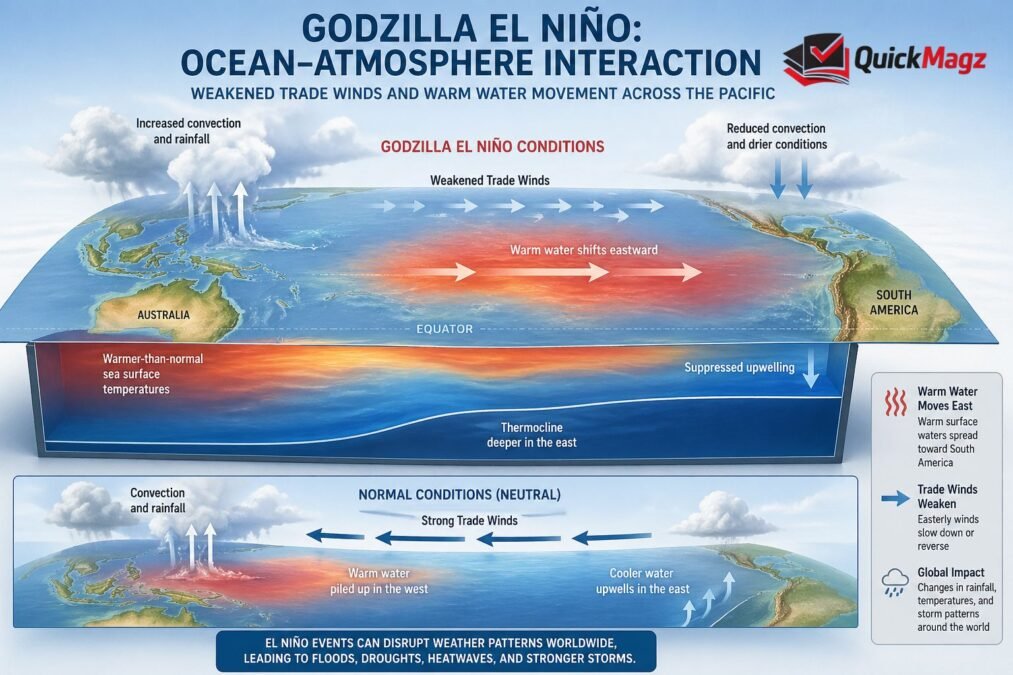
Under normal conditions, trade winds push warm Pacific surface water toward the western Pacific near Indonesia and Australia. During El Niño, those winds weaken. Warm water spreads eastward across the tropical Pacific, changing where heat and moisture rise into the atmosphere.
That shift affects the jet stream, storm paths, and rainfall patterns. Some regions become unusually wet, while others become unusually dry. This is why El Niño is not just a Pacific Ocean event. It is a global climate pattern.
NOAA and the International Research Institute regularly track ENSO because it helps forecasters understand seasonal risks months in advance. (Climate.gov)
Global Heat Could Rise
One major impact of Godzilla El Niño is higher global temperature. El Niño releases ocean heat into the atmosphere, often helping push global temperatures upward.
This does not mean El Niño “causes” climate change. It is a natural climate cycle. However, when a strong El Niño happens in a warming world, the extra heat can make already high temperatures feel even more extreme.
A strong El Niño can increase the risk of heatwaves, warmer winters, record-breaking ocean temperatures, and stress on people, animals, and ecosystems.
North America May See Weather Swings
In North America, El Niño often has its strongest influence during winter. The southern United States may see wetter conditions, while parts of the northern United States and Canada may experience milder winter temperatures.
A Godzilla El Niño could increase the chance of heavy rain in California, the Gulf Coast, and the southeastern U.S. In some areas, this may help ease drought. In others, it can create flooding, landslides, road damage, and pressure on drainage systems.
The Pacific Northwest and parts of western Canada may see warmer and drier conditions, which can affect snowpack. That matters because mountain snow works like a natural water reservoir for spring and summer.
South America Could Face Flooding
South America is often one of the regions most directly affected by El Niño. Countries along the Pacific coast, especially Peru and Ecuador, may experience heavier rainfall and flooding.
Warmer Pacific waters can also disrupt fisheries. Fish populations often move when ocean temperatures change, which can hurt fishing communities and local economies.
Inland areas may experience different effects. Some parts of the Amazon can become drier, increasing stress on forests, rivers, crops, and wildlife.
Asia May Face Drought Risks
Across parts of Asia, El Niño can reduce rainfall and weaken monsoon patterns. This can create drought risks in countries that depend heavily on seasonal rain for farming and water supplies.
India, Southeast Asia, Indonesia, and the Philippines can all be affected in different ways. Reduced rainfall may lower crop yields, shrink water reservoirs, and increase wildfire risk.
During strong El Niño years, Indonesia has often faced severe dry conditions. When forests and peatlands become too dry, fires can spread quickly and create dangerous smoke pollution.
Australia Could Become Hotter and Drier
Australia is one of the regions commonly linked with El Niño drought impacts. A Godzilla El Niño could increase the risk of hotter days, lower rainfall, dry soil, and dangerous bushfire conditions.
When vegetation dries out, fire seasons can become longer and more intense. Farmers may also face reduced pasture growth, water shortages, and lower crop production.
This does not mean every part of Australia will be dry at the same time. Local weather still matters. But a strong El Niño can tilt the odds toward heat and dryness.
Africa May See Uneven Rainfall
Africa’s response to El Niño can vary by region. Some areas may become wetter, while others face drought. East Africa can sometimes see heavier rainfall, raising flood risks. Southern Africa, however, is often more vulnerable to dry conditions during El Niño.
This matters because many communities depend on rain-fed agriculture. If seasonal rains fail or arrive at the wrong time, food production can suffer.
A strong El Niño can also increase the risk of food insecurity, especially in areas already dealing with poverty, conflict, or weak infrastructure.
Europe May Feel Indirect Effects
Europe is not always affected by El Niño as directly as regions near the Pacific, but it can still feel indirect impacts. Changes in global circulation patterns may influence winter temperatures, rainfall, and storm behavior.
The effects are less predictable than in places like Australia, Indonesia, or western South America. Still, a powerful El Niño can add uncertainty to seasonal forecasts, especially when combined with other climate patterns in the Atlantic and Arctic.
Storms May Shift
El Niño can influence tropical cyclone activity. In the Atlantic, El Niño often creates stronger wind shear, which can suppress hurricane development. In the central and eastern Pacific, however, conditions may become more favorable for tropical storms.
This does not guarantee fewer or weaker storms everywhere. A single storm can still be destructive. But El Niño changes the background conditions that help storms form, strengthen, or weaken.
A Godzilla El Niño could make these storm-pattern shifts more noticeable.
Rainfall Extremes Could Increase
One of the biggest concerns with a strong El Niño is rainfall imbalance. Some places receive too much rain, while others receive too little.
Heavy rainfall can trigger flash floods, landslides, sewage overflow, crop damage, and disease outbreaks. Drought can reduce drinking water supplies, damage crops, increase wildfire risk, and raise electricity costs where hydropower is important.
The problem is not only the amount of rain. Timing matters too. Rain falling too early, too late, or all at once can be just as damaging as a complete lack of rain.
Food Prices May Rise
Weather shocks often become food shocks. A Godzilla El Niño could affect crops such as rice, wheat, corn, coffee, cocoa, sugar, and palm oil, depending on which regions are hit hardest.
Drought can reduce yields. Flooding can destroy fields. Heat can stress livestock. Fisheries can decline when ocean temperatures shift.
When several major producing regions face weather problems at the same time, global food prices can rise. This affects households, businesses, and governments, especially in countries that rely on imports.
Oceans and Coral Reefs May Suffer
Strong El Niño events can warm oceans and damage marine ecosystems. Coral reefs are especially vulnerable. When water stays too warm for too long, corals can bleach, meaning they lose the algae that give them color and energy.
Bleached coral is not always dead, but repeated or prolonged heat stress can kill reefs. That harms fish, tourism, coastal protection, and marine biodiversity.
Warmer waters can also change where fish live, affecting commercial fishing and coastal communities.
Health Risks Could Grow
A Godzilla El Niño may also affect public health. Heatwaves can increase heat exhaustion and heatstroke. Flooding can contaminate water supplies. Drought can reduce clean water access. Wildfire smoke can worsen asthma and other breathing problems.
In some regions, changes in rainfall and temperature may influence mosquito-borne diseases. Standing water after floods can create breeding grounds for mosquitoes, while warmer temperatures may expand disease risk zones.
Health systems often feel these impacts most in vulnerable communities.
Economies Could Be Hit Hard
Extreme weather is expensive. Floods damage roads, bridges, homes, and businesses. Drought can hurt agriculture, hydropower, shipping, and drinking water systems. Wildfires can destroy property and force evacuations.
A strong El Niño can also affect insurance costs, energy demand, supply chains, and government disaster budgets.
For businesses, the risks are practical. Shipping delays, crop shortages, higher raw material costs, and power disruptions can all trace back to weather instability.
Can We Predict It?
Scientists can forecast El Niño months ahead, but exact local impacts are harder to predict. ENSO forecasts are useful because they show increased probabilities, not certainties.
For example, NOAA’s Climate Prediction Center reported in April 2026 that El Niño was likely to emerge during May–July 2026 and persist through at least the end of 2026. (Climate Prediction Center)
That kind of forecast helps governments, farmers, water managers, and emergency agencies prepare. Still, every El Niño is different. Strength, timing, ocean temperature patterns, and regional climate conditions all shape the final outcome.
How Communities Can Prepare
Preparation can reduce damage. Governments can improve flood defenses, update emergency plans, protect water supplies, and support farmers with early warnings.
Farmers can adjust planting dates, crop choices, irrigation plans, and livestock management. Cities can clear drainage systems, prepare cooling centers, and strengthen wildfire response.
Families can also take basic steps: store emergency water, prepare for power outages, follow local weather alerts, and understand flood or heat risks in their area.
Climate Change Makes It More Serious
El Niño has always existed, but climate change changes the background conditions. A warmer atmosphere can hold more moisture, which can make heavy rainfall more intense. Hotter baseline temperatures can make heatwaves more dangerous.
This is why a Godzilla El Niño today may have different consequences than a strong El Niño decades ago. The natural cycle is happening on top of a warmer planet.
The World Meteorological Organization notes that El Niño and La Niña updates are important for governments, disaster agencies, and policymakers because they help guide preparation for climate-related impacts. (World Meteorological Organization)
Final Thoughts
A Godzilla El Niño could impact weather worldwide by shifting rainfall, raising temperatures, increasing drought risk, intensifying floods, disrupting food systems, and stressing oceans and ecosystems.
It will not affect every country in the same way. Some regions may face floods, while others deal with drought. Some may see warmer winters, while others struggle with failed rains or wildfire danger.
The key point is simple: El Niño is not just a weather story. It is a global risk pattern that touches food, water, health, energy, and economies. Understanding it early gives people and communities a better chance to prepare before the worst impacts arrive.
FAQs About Godzilla El Niño
1. What is Godzilla El Niño?
Godzilla El Niño is an informal term used to describe an extremely strong El Niño event. It refers to periods when ocean warming in the Pacific becomes unusually intense, leading to major global weather disruptions.
2. How does Godzilla El Niño affect global weather?
It shifts rainfall, temperature, and storm patterns worldwide. Some regions experience heavy rainfall and flooding, while others face drought, heatwaves, or reduced water supply.
3. How often does a Godzilla El Niño occur?
Very strong El Niño events are rare. They typically happen every 10 to 20 years, although timing can vary depending on ocean and atmospheric conditions.
4. Is Godzilla El Niño dangerous?
It can be, especially when it triggers extreme weather events. Floods, droughts, wildfires, and heatwaves linked to strong El Niño events can impact health, food supply, and infrastructure.
5. Can we predict Godzilla El Niño in advance?
Scientists can forecast El Niño months ahead using climate models and ocean data. While predictions are not perfect, they help governments and communities prepare for possible impacts.
